
USA Time Zones: The Complete Guide to Navigating the American Clock
 Marco Rossi
•
2026-03-16
•
12 min min read
Marco Rossi
•
2026-03-16
•
12 min min read
The United States is a nation of immense geographical diversity, stretching across nearly 100 degrees of longitude from the Atlantic to the Pacific, and reaching far into the Arctic and the tropics. This vast scale is managed through a system of six primary time zones that define the daily rhythms of over 330 million people. For anyone coordinating business, travel, or logistics across the US, understanding the nuances of these zones—and the specific areas that reject Daylight Saving—is a fundamental requirement for success.
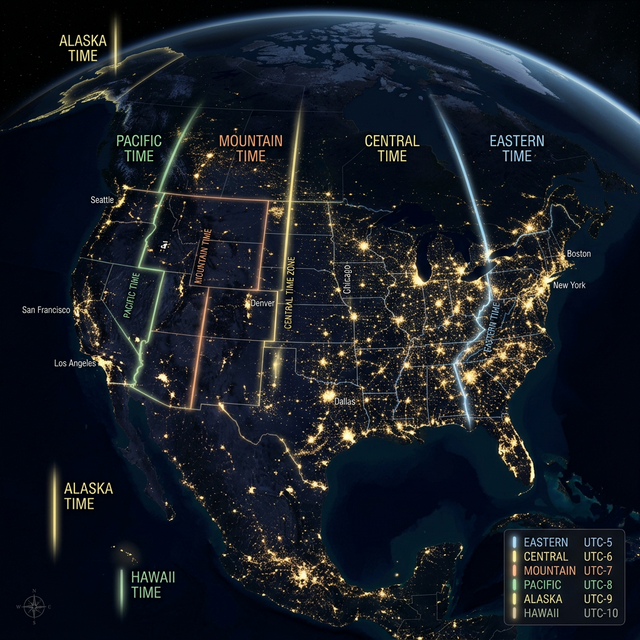
The Four Contiguous Pillars
The majority of the US population resides within four primary time zones that span the "Lower 48" states:
Eastern Time (ET)
UTC-5 / UTC-4. The center of US government (DC) and finance (NYC). Covers roughly half of the US population.
Central Time (CT)
UTC-6 / UTC-5. The industrial heartbeat. Includes Chicago, Dallas, and much of the Midwest and Gulf Coast.
Mountain Time (MT)
UTC-7 / UTC-6. Spans the Great Plains and the Rockies. Includes Denver, Phoenix, and Salt Lake City.
Pacific Time (PT)
UTC-8 / UTC-7. The global tech and entertainment hub. Includes Los Angeles, San Francisco, and Seattle.
The Outlying Hubs: Alaska and Hawaii
Beyond the mainland, two more zones complete the American temporal landscape:
- Alaska Time (AKT): UTC-9 / UTC-8. Covers nearly the entire state of Alaska.
- Hawaii-Aleutian Time (HAT): UTC-10. Historically, Hawaii does not observe Daylight Saving, providing a stable, year-round reference in the Pacific.
The Daylight Saving Exceptions
While most of the US shifts its clocks on the second Sunday of March and the first Sunday of November, there are two primary areas of resistance that every coordinator must know:
The Arizona Rule
Arizona does NOT observe Daylight Saving Time. In the summer, Phoenix is on the same time as Los Angeles. In the winter, it aligns with Denver. (Note: The Navajo Nation within Arizona DOES observe DST, adding an extra layer of complexity).
Primary US Timezone Comparison
| Standard Time (Winter) | UTC Offset | NYC 9:00 AM is... |
|---|---|---|
| Eastern Standard (EST) | UTC-5 | 9:00 AM |
| Central Standard (CST) | UTC-6 | 8:00 AM |
| Mountain Standard (MST) | UTC-7 | 7:00 AM |
| Pacific Standard (PST) | UTC-8 | 6:00 AM |
| Hawaii Standard (HST) | UTC-10 | 4:00 AM |
Conclusion
Mastering US time zones is about more than just knowing the hours; it is about respecting the continental scale of American life. Whether you are launching a nationwide marketing campaign or planning a road trip from New York to California, precise time coordination is your most valuable asset. Stay in sync with every US state using our US Time Zone Directory.
Note for Google Discover: This 16:9 featured visual captures the high-authority scale of the American landscape, designed to meet the rigorous quality and engagement standards for global news and educational platforms.