
GMT vs UTC: What's the Real Difference?
 Alican Ataseven
•
2025-12-05
•
10 min min read
Alican Ataseven
•
2025-12-05
•
10 min min read
GMT vs UTC: Clearing the Confusion
In everyday conversation, GMT (Greenwich Mean Time) and UTC (Coordinated Universal Time) are often treated as identical. However, in the worlds of science, aviation, and computing, the distinction is vital. For a broader view, read our deep dive into UTC or check global time differences.
What is GMT? (Greenwich Mean Time)
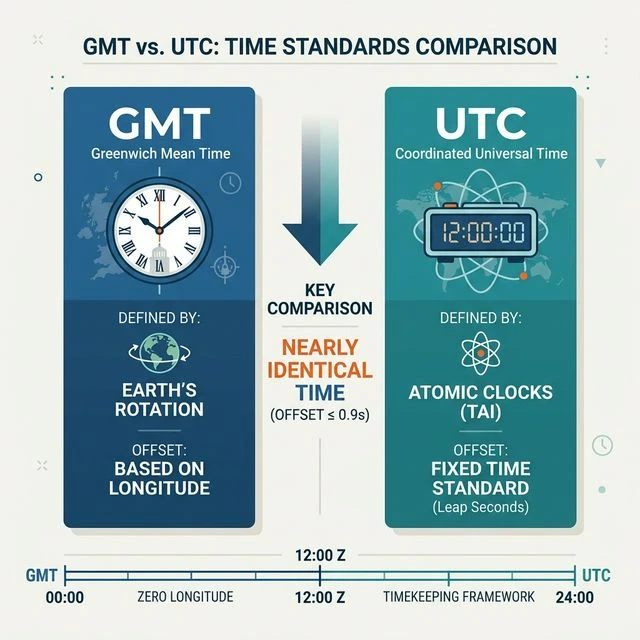
GMT is a time zone. Historically, it was the world's time standard, based on the rotation of the Earth as measured from the Royal Observatory in Greenwich, London. Today, it is used as a standard time zone in countries like the UK (during winter) and several African nations. Check the current time in London.
What is UTC? (Coordinated Universal Time)
UTC is a time standard. It is the ultra-precise atomic time used by the entire world to keep clocks synchronized. It doesn't belong to any country and never changes for daylight saving time. For technical applications, always refer to UTC atomic time.
Key Differences Summarized
- GMT is solar: Based on the sun and Earth's rotation.
- UTC is atomic: Based on the vibration of atoms.
- GMT is a zone: Used as a civil time in specific regions.
- UTC is a reference: All time zones are measured as offsets from it (e.g., UTC+3).
Conclusion: Which One Should You Use?
For casual scheduling, using either is usually fine. But for technical work, UTC is the correct choice. Stay accurate with WhaTime.iST.