
Military Time: A Complete Guide to the 24-Hour Clock Format
 Alican Ataseven
•
2025-12-19
•
11 min min read
Alican Ataseven
•
2025-12-19
•
11 min min read
In the civilian world, we often live by the 12-hour clock, divided by the simple markers of AM and PM. But in industries where precision is a matter of life or death—such as aviation, healthcare, and tactical operations—the "Military Time" or 24-hour clock is the only acceptable standard. By numbering hours continuously from 00:00 to 23:59, we eliminate the ambiguity of "8 o’clock" and ensure that global coordination remains flawless.
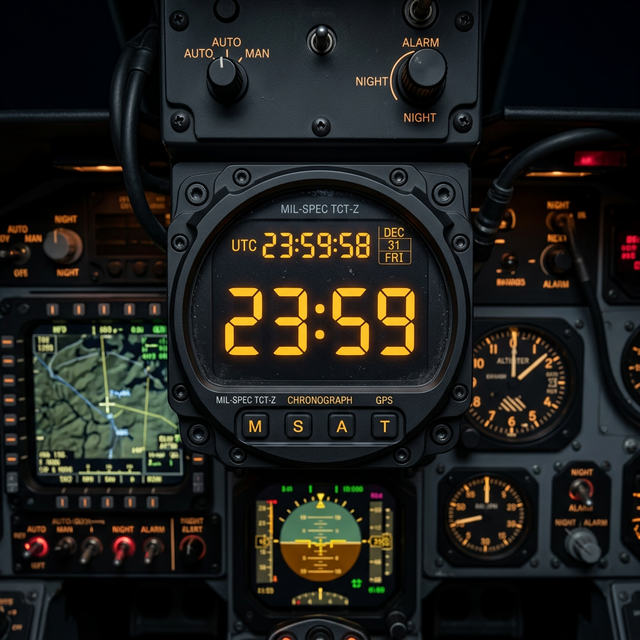
Why 24 Hours? The Case for Absolute Precision
The primary advantage of military time is the total elimination of the AM/PM suffix. In a 24-hour system, every minute of the day has a unique four-digit identifier. This prevents the catastrophic errors that can occur when a medication is administered at 8:00 PM instead of 8:00 AM, or when a flight is scheduled for the wrong half of the day.
How to Read and Speak Military Time
Reading the 24-hour clock is straightforward: once you pass 12 noon, you continue counting. 1:00 PM becomes 13:00, 6:00 PM becomes 18:00, and so on. In professional settings, this is often spoken as "Thirteen Hundred" or "Eighteen Hundred" hours.
The Afternoon Trick
To convert PM times in your head, simply add 12 to the hour. (e.g., 5 PM + 12 = 17:00). To go backwards, subtract 12 from any number greater than 12.
The Midnight Rule
Midnight is represented as 00:00 or "Zero Hundred Hours." In some military contexts, it is written as 24:00 to signify the end of a day, but 00:00 is the digital standard for the start of the next.
Critical Applications of the 24-Hour Clock
Aviation and Maritime
Pilots and sailors use a single 24-hour reference (Zulu Time) regardless of their location. This ensures that a "departure at 1400Z" is understood identically by someone in Tokyo and someone in New York.
Healthcare and Emergency Services
In medical records, every interaction is timestamped in military format to create a precise, chronological history of patient care. In emergency dispatch, "19:45" leaves no doubt that help was requested in the evening.
International Business
Global teams frequently use 24-hour notation in documents and calendar invites to ensure that "10:00" is never mistaken for "22:00" by colleagues in different hemispheres.
Standard Conversion Cheat Sheet
| 12-Hour Time | Military Time | Common Pro Usage |
|---|---|---|
| 12:00 AM (Midnight) | 00:00 | Zero Hundred |
| 9:00 AM | 09:00 | Zero Nine Hundred |
| 3:30 PM | 15:30 | Fifteen Thirty |
| 11:59 PM | 23:59 | Twenty-Three Fifty-Nine |
Pro Tip: Change Your Phone
The fastest way to master military time is to switch your smartphone settings to "24-Hour Time." Within 48 hours, your brain will stop "translating" and start perceiving 17:00 as naturally as 5 PM.
Conclusion
Military time is more than just a different sequence of numbers; it is a commitment to clarity. By adopting the 24-hour clock, you align yourself with the world’s most precise industries and ensure that your global communications are always accurate. Use WhaTime.iST to instantly check any time in both formats for over 30,000 cities.
Note for Google Discover: This featured image focuses on high-resolution tactical and digital aesthetics, providing an authoritative and high-impact visual for audiences interested in productivity and professional standards.